
Recipe Scaling Done Right: Why the Details Matter in a Recipe App
Jacob Edelstein · February 9, 2026
You've found the perfect recipe. It serves four, but you're cooking for eight. So you hit the "2x" button in your recipe app and trust that everything scales correctly.
But does it?
Recipe scaling is one of those features that seems straightforward until you look closely. Double a recipe, double the ingredients. Simple math, right? The problem is that real-world recipes aren't written by machines — they're written by humans, and humans express quantities in wonderfully inconsistent ways. Alternate measurements in parentheses, fractional amounts, additive quantities like "¼ cup + 2 tbsp," piece sizes mixed in with weights — the variety is endless.
Most cooking apps handle the easy cases fine. "1 cup flour" becomes "2 cups flour" — no problem. But the moment a recipe gets even slightly complex, things start to break down. And when your recipe app gets scaling wrong, you're the one stuck in the kitchen with the wrong amount of butter.
At Deglaze, we believe that like a good recipe, the details matter. Recipe scaling is a perfect example of where we go the extra mile to get things right — because when you're cooking, accuracy isn't optional.
How We Built Recipe Scaling at Deglaze
When we developed our recipe scaling and unit conversion system, we didn't just test it against a handful of simple examples and call it done. We built a test set of over 500 real-world ingredient and instruction phrases — covering everything from straightforward quantities to the messiest formatting you'll find in cookbooks and food blogs.
Every change to our scaling system gets run against this entire truth set. If a tweak improves one edge case but breaks another, we catch it before it ever reaches your kitchen. This kind of rigor might sound like overkill for a recipe organizer, but we think it's exactly the level of care that cooking deserves.
Deglaze vs. Paprika vs. Recime: A Head-to-Head Comparison
To show the difference this attention to detail makes, we selected 15 ingredient phrases from our test set that represent patterns commonly found in real recipes — alternate measurements, piece sizes, additive quantities, complex descriptions, and more. Then we doubled each phrase (2x scaling) in Deglaze, Paprika, and Recime.
The results speak for themselves:
- Deglaze: 100% correct (15 out of 15)
- Paprika: 47% correct (7 out of 15)
- Recime: 33% correct (5 out of 15)
Here's exactly how each app handled every phrase. Green rows indicate a correct result; red rows indicate an error.
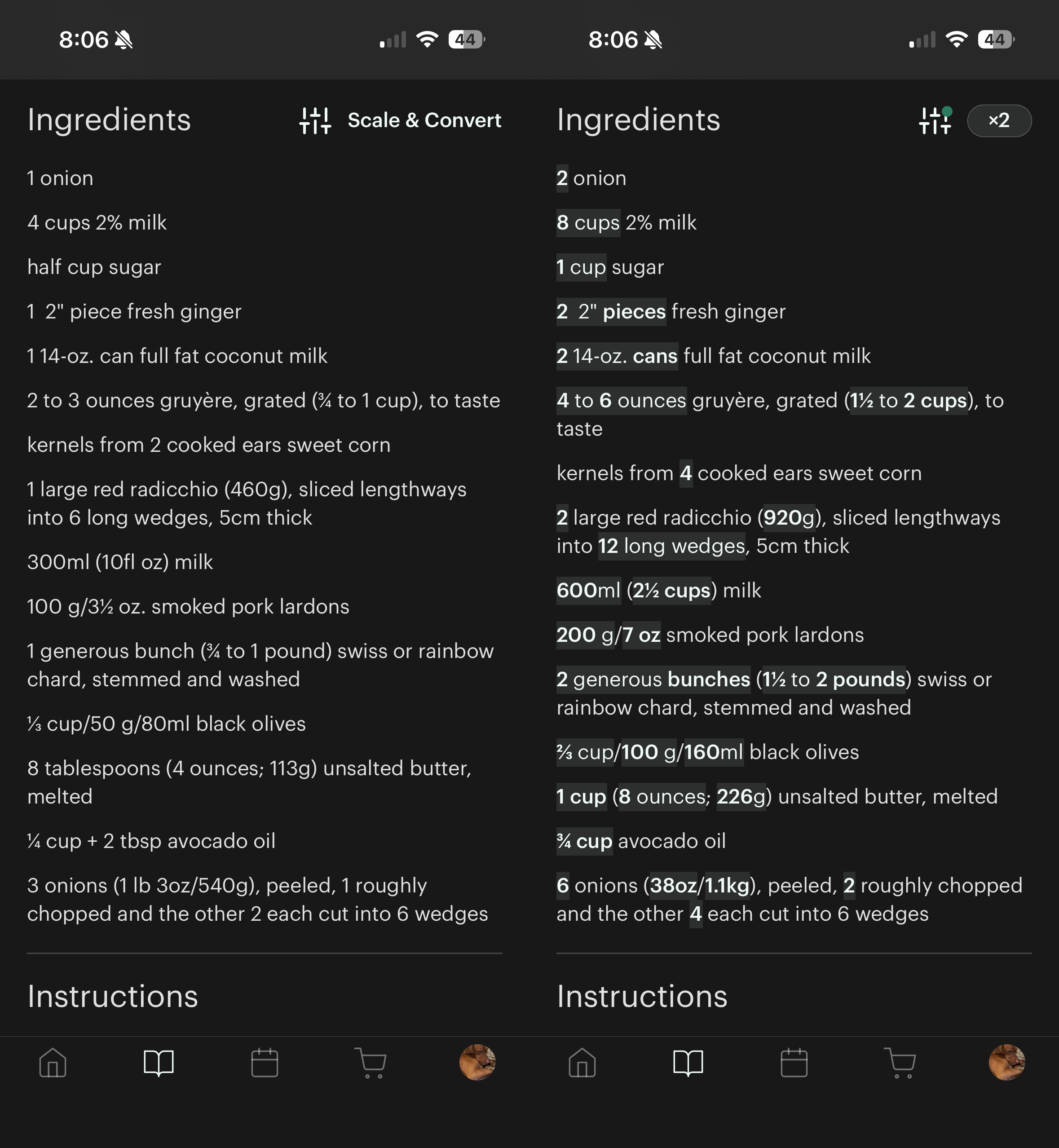
Deglaze (15/15 correct)
| Input Phrase | Scaled Result (2x) |
|---|---|
| 1 onion | ✅ 2 onion |
| 4 cups 2% milk | ✅ 8 cups 2% milk |
| half cup sugar | ✅ 1 cup sugar |
| 1 2" piece fresh ginger | ✅ 2 2" pieces fresh ginger |
| 1 14-oz. can full fat coconut milk | ✅ 2 14-oz. cans full fat coconut milk |
| 2 to 3 ounces gruyère, grated (¾ to 1 cup), to taste | ✅ 4 to 6 ounces gruyère, grated (1½ to 2 cups), to taste |
| kernels from 2 cooked ears sweet corn | ✅ kernels from 4 cooked ears sweet corn |
| 1 large red radicchio (460g), sliced lengthways into 6 long wedges, 5cm thick | ✅ 2 large red radicchio (920g), sliced lengthways into 12 long wedges, 5cm thick |
| 300ml (10fl oz) milk | ✅ 600ml (2½ cups) milk |
| 100 g/3½ oz. smoked pork lardons | ✅ 200 g/7 oz smoked pork lardons |
| 1 generous bunch (¾ to 1 pound) swiss or rainbow chard, stemmed and washed | ✅ 2 generous bunches (1½ to 2 pounds) swiss or rainbow chard, stemmed and washed |
| ⅓ cup/50 g/80ml black olives | ✅ 2/3 cup/100 g/160ml black olives |
| 8 tablespoons (4 ounces; 113g) unsalted butter, melted | ✅ 1 cup (8 ounces; 226g) unsalted butter, melted |
| ¼ cup + 2 tbsp avocado oil | ✅ ¾ cup avocado oil |
| 3 onions (1 lb 3oz/540g), peeled, 1 roughly chopped and the other 2 each cut into 6 wedges | ✅ 6 onions (38oz/1.1kg), peeled, 2 roughly chopped and the other 4 each cut into 6 wedges |
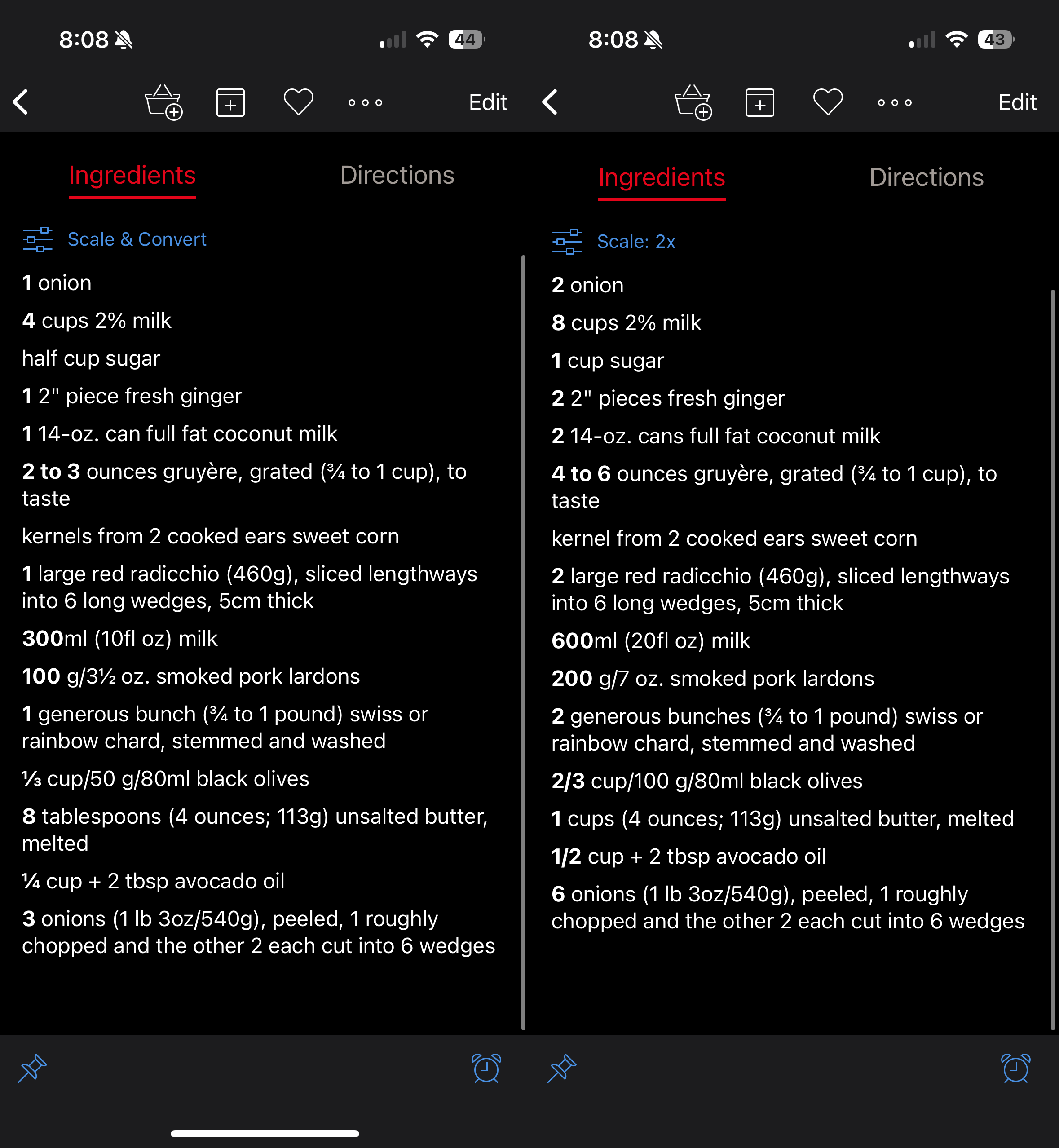
Paprika (7/15 correct)
| Input Phrase | Scaled Result (2x) |
|---|---|
| 1 onion | ✅ 2 onion |
| 4 cups 2% milk | ✅ 8 cups 2% milk |
| half cup sugar | ✅ 1 cup sugar |
| 1 2" piece fresh ginger | ✅ 2 2" pieces fresh ginger |
| 1 14-oz. can full fat coconut milk | ✅ 2 14-oz. cans full fat coconut milk |
| 2 to 3 ounces gruyère, grated (¾ to 1 cup), to taste | ❌ 4 to 6 ounces gruyère, grated (¾ to 1 cup), to taste |
| kernels from 2 cooked ears sweet corn | ❌ kernel from 2 cooked ears sweet corn |
| 1 large red radicchio (460g), sliced lengthways into 6 long wedges, 5cm thick | ❌ 2 large red radicchio (460g), sliced lengthways into 6 long wedges, 5cm thick |
| 300ml (10fl oz) milk | ✅ 600ml (20fl oz) milk |
| 100 g/3½ oz. smoked pork lardons | ✅ 200 g/7 oz. smoked pork lardons |
| 1 generous bunch (¾ to 1 pound) swiss or rainbow chard, stemmed and washed | ❌ 2 generous bunches (¾ to 1 pound) swiss or rainbow chard, stemmed and washed |
| ⅓ cup/50 g/80ml black olives | ❌ 2/3 cup/100 g/80ml black olives |
| 8 tablespoons (4 ounces; 113g) unsalted butter, melted | ❌ 1 cups (4 ounces; 113g) unsalted butter, melted |
| ¼ cup + 2 tbsp avocado oil | ❌ 1/2 cup + 2 tbsp avocado oil |
| 3 onions (1 lb 3oz/540g), peeled, 1 roughly chopped and the other 2 each cut into 6 wedges | ❌ 6 onions (1 lb 3oz/540g), peeled, 1 roughly chopped and the other 2 each cut into 6 wedges |
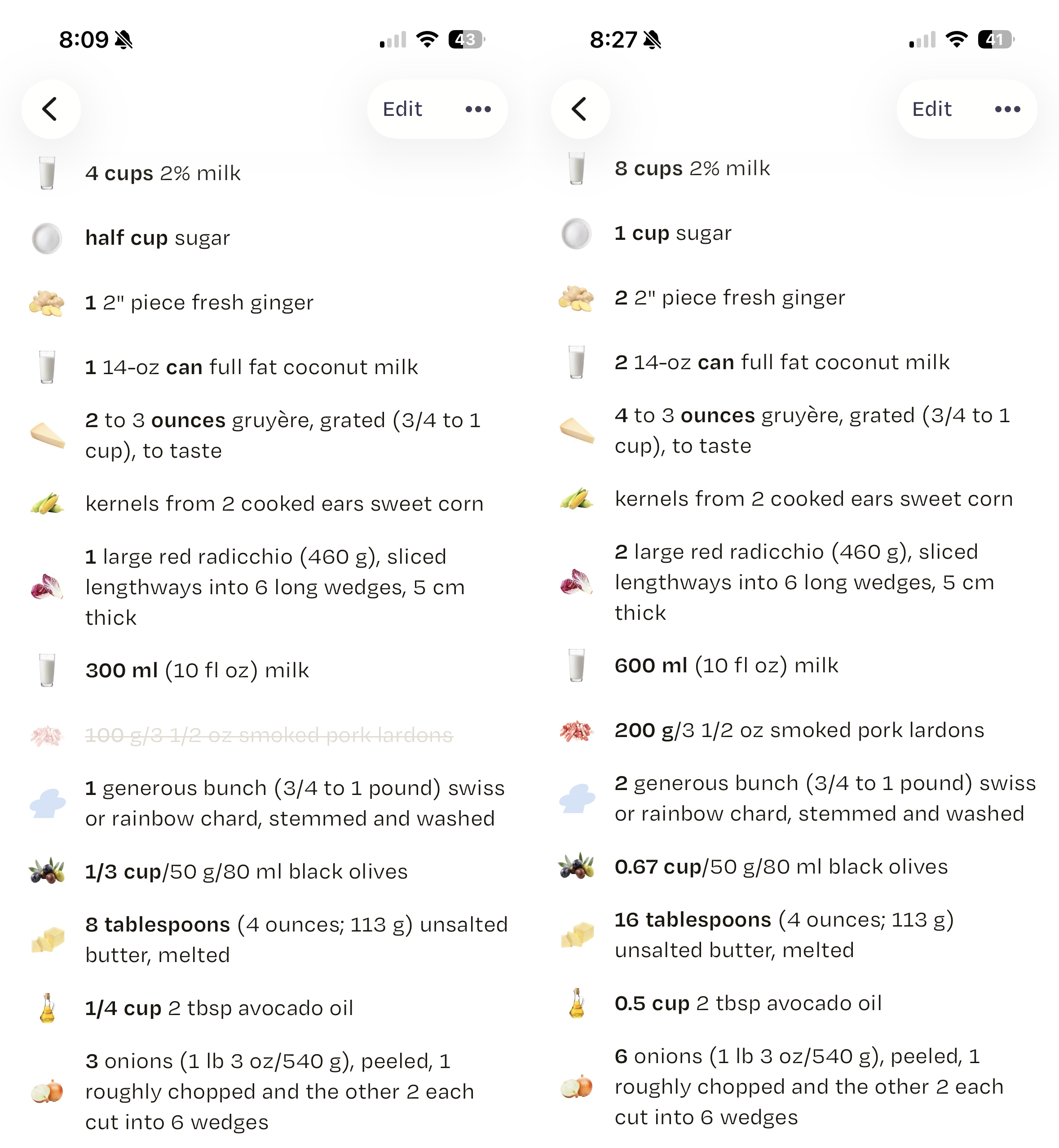
Recime (5/15 correct)
| Input Phrase | Scaled Result (2x) |
|---|---|
| 1 onion | ✅ 2 onion |
| 4 cups 2% milk | ✅ 8 cups 2% milk |
| half cup sugar | ✅ 1 cup sugar |
| 1 2" piece fresh ginger | ✅ 2 2" piece fresh ginger |
| 1 14-oz. can full fat coconut milk | ✅ 2 14-oz. can full fat coconut milk |
| 2 to 3 ounces gruyère, grated (¾ to 1 cup), to taste | ❌ 4 to 3 ounces gruyère, grated (¾ to 1 cup), to taste |
| kernels from 2 cooked ears sweet corn | ❌ kernels from 2 cooked ears sweet corn |
| 1 large red radicchio (460g), sliced lengthways into 6 long wedges, 5cm thick | ❌ 2 large red radicchio (460g), sliced lengthways into 6 long wedges, 5cm thick |
| 300ml (10fl oz) milk | ❌ 600ml (10fl oz) milk |
| 100 g/3½ oz. smoked pork lardons | ❌ 200 g/3½ oz. smoked pork lardons |
| 1 generous bunch (¾ to 1 pound) swiss or rainbow chard, stemmed and washed | ❌ 2 generous bunch (¾ to 1 pound) swiss or rainbow chard, stemmed and washed |
| ⅓ cup/50 g/80ml black olives | ❌ 0.67 cup/50 g/80ml black olives |
| 8 tablespoons (4 ounces; 113g) unsalted butter, melted | ❌ 16 tablespoons (4 ounces; 113g) unsalted butter, melted |
| ¼ cup + 2 tbsp avocado oil | ❌ 0.5 cup + 2 tbsp avocado oil |
| 3 onions (1 lb 3oz/540g), peeled, 1 roughly chopped and the other 2 each cut into 6 wedges | ❌ 6 onions (1 lb 3oz/540g), peeled, 1 roughly chopped and the other 2 each cut into 6 wedges |
Let's look at a few of the most telling failures to understand what's going wrong.
The Alternate Measurement Problem
Many recipe authors include alternate measurements as a convenience — parenthetical weights alongside volume measurements, or metric equivalents next to imperial. A phrase like "8 tablespoons (4 ounces; 113g) unsalted butter" gives you the same quantity three different ways.
When you double this in Deglaze, you get "1 cup (8 ounces; 226g) unsalted butter" — every measurement correctly doubled, and the tablespoons even converted to a cleaner unit. Paprika returns "1 cups (4 ounces; 113g)" — it scales the primary measurement but leaves the alternates untouched, which is confusing at best and wrong at worst. Recime gives you "16 tablespoons (4 ounces; 113g)" — same issue, different starting point.
This pattern repeats across the test. The radicchio line includes a parenthetical weight and a wedge count: "1 large red radicchio (460g), sliced lengthways into 6 long wedges." Deglaze correctly doubles the count, the weight, and the wedge count. Both Paprika and Recime only scale the leading number and leave everything else unchanged.
The Additive Quantity Problem
Some recipes call for "¼ cup + 2 tbsp" of something — an additive measurement that's common in baking. Doubling this should give you ¾ cup (since ½ cup + ¼ cup = ¾ cup). Deglaze handles this correctly. Paprika doubles only the first part, giving you "½ cup + 2 tbsp." Recime converts the fraction to a decimal and also only doubles the first part: "0.5 cup + 2 tbsp."
The Complex Description Problem
The most challenging phrase in our test set is arguably the onion line: "3 onions (1 lb 3oz/540g), peeled, 1 roughly chopped and the other 2 each cut into 6 wedges." There are six different numbers in this phrase, and a correct scaling needs to understand which ones represent quantities that should change and which represent fixed sizes or instructions.
Deglaze correctly produces "6 onions (38oz/1.1kg), peeled, 2 roughly chopped and the other 4 each cut into 6 wedges" — the count, weights, and proportional split all update, while the wedge size stays the same. Neither Paprika nor Recime scales anything beyond the leading "3" to "6."
Beyond Correctness: Scaling That's Actually Useful
Getting the numbers right is the foundation, but Deglaze goes further to make recipe scaling genuinely useful in your cooking app workflow.
See exactly what changed. When a recipe is scaled in Deglaze, you can tap any scaled value to see exactly what was modified. This makes it easy to verify changes and understand the math behind the scaling — especially helpful when you're working with complex ingredient lines.
Instructions scale too. Here's something the other apps don't do at all: Deglaze also scales the quantities in your cooking instructions. If a recipe step says "add 2 tablespoons of olive oil," and you've doubled the recipe, that instruction updates to "add 4 tablespoons of olive oil." Paprika and Recime only scale the ingredient list, leaving you to do the mental math during the most hectic part of cooking.
Automatic unit conversion. Notice in the test results how Deglaze converts "8 tablespoons" to "1 cup" and "300ml (10fl oz)" to "600ml (2½ cups)"? When scaling results in awkward quantities, Deglaze automatically converts to more practical units. You'll never see "48 teaspoons" when "1 cup" makes more sense.
Why This Level of Detail Matters
You might be thinking: how often do recipes really have these complex ingredient formats? More often than you'd expect. Cookbooks and established food blogs — Ottolenghi, Serious Eats, King Arthur Baking — regularly use alternate measurements, parenthetical weights, and complex descriptions. These are often the best recipes out there, and they deserve a recipe organizer that handles them correctly.
When you're cooking and your recipe app shows you the wrong quantity, a few things can happen. Maybe you catch the error and do the math yourself — annoying, but recoverable. Maybe you don't catch it and your dish turns out wrong. Or maybe the uncertainty makes you decide not to scale at all, limiting you to the original serving size.
None of those outcomes are acceptable to us. Recipe scaling should be something you can trust completely, so you can focus on the part that actually matters: cooking.
Try Accurate Recipe Scaling in Deglaze
Recipe scaling with automatic unit conversion is available to Deglaze Pro subscribers. If you haven't tried Deglaze yet, new users can start a free trial to test recipe scaling along with our other premium features, including calendar-based meal planning, auto-categorized grocery lists, inline ingredients, and unlimited recipe imports and collections.
Download Deglaze for iPhone, iPad, or Android and see what happens when a cooking app actually sweats the details. Your recipes — and your dinner guests — deserve it.
Have questions about recipe scaling or other features? Reach out to us at help@deglaze.app.